Read this before you add one more bottle to the drawer by your stove.
Every enzyme gave me two good weeks, then the heavy dinners won again. Five weeks after my son's jar, I ate the whole plate at the restaurant where I'd spent my husband's 60th in the car.

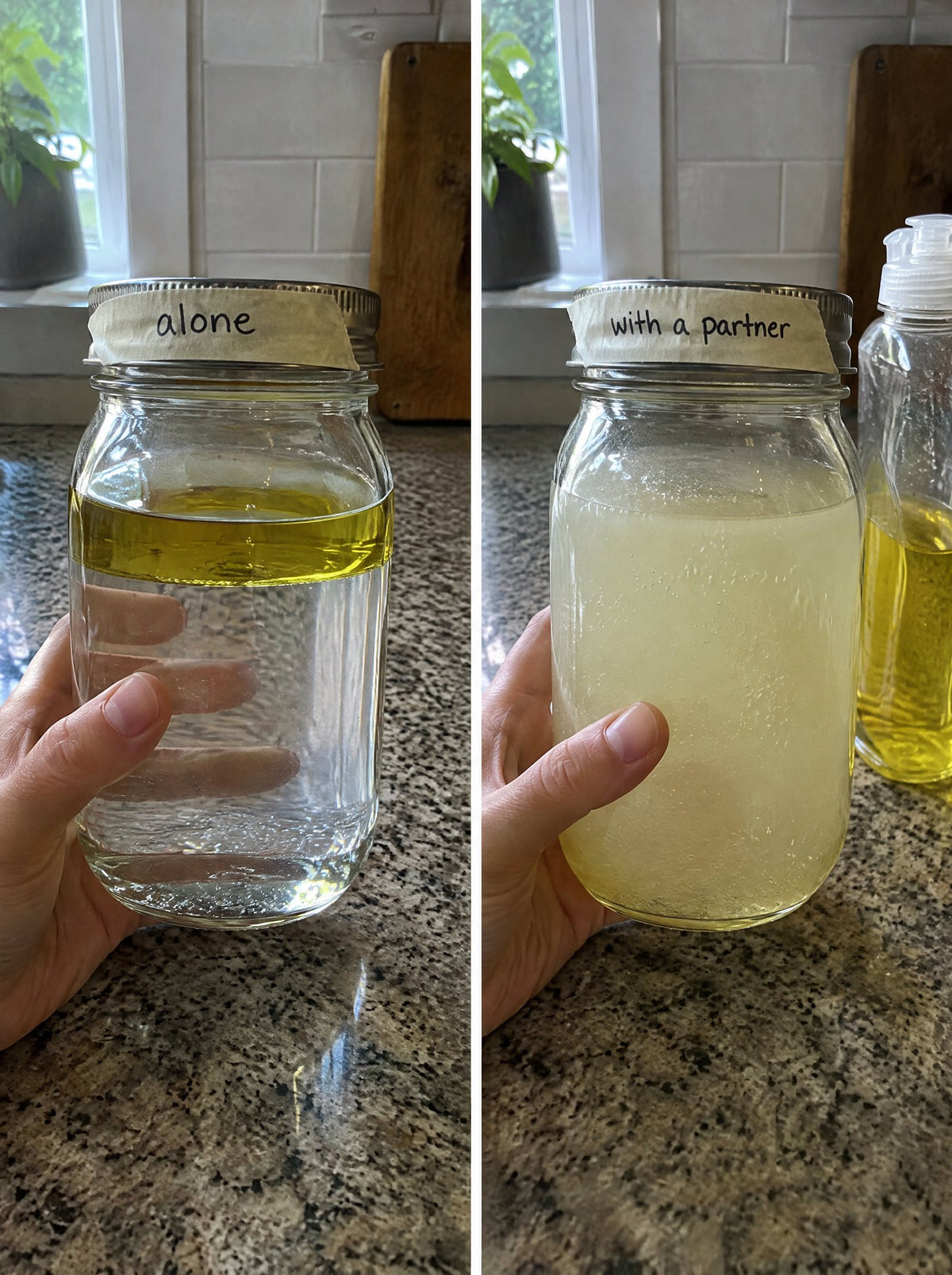
The jar on the right is my son's doing.
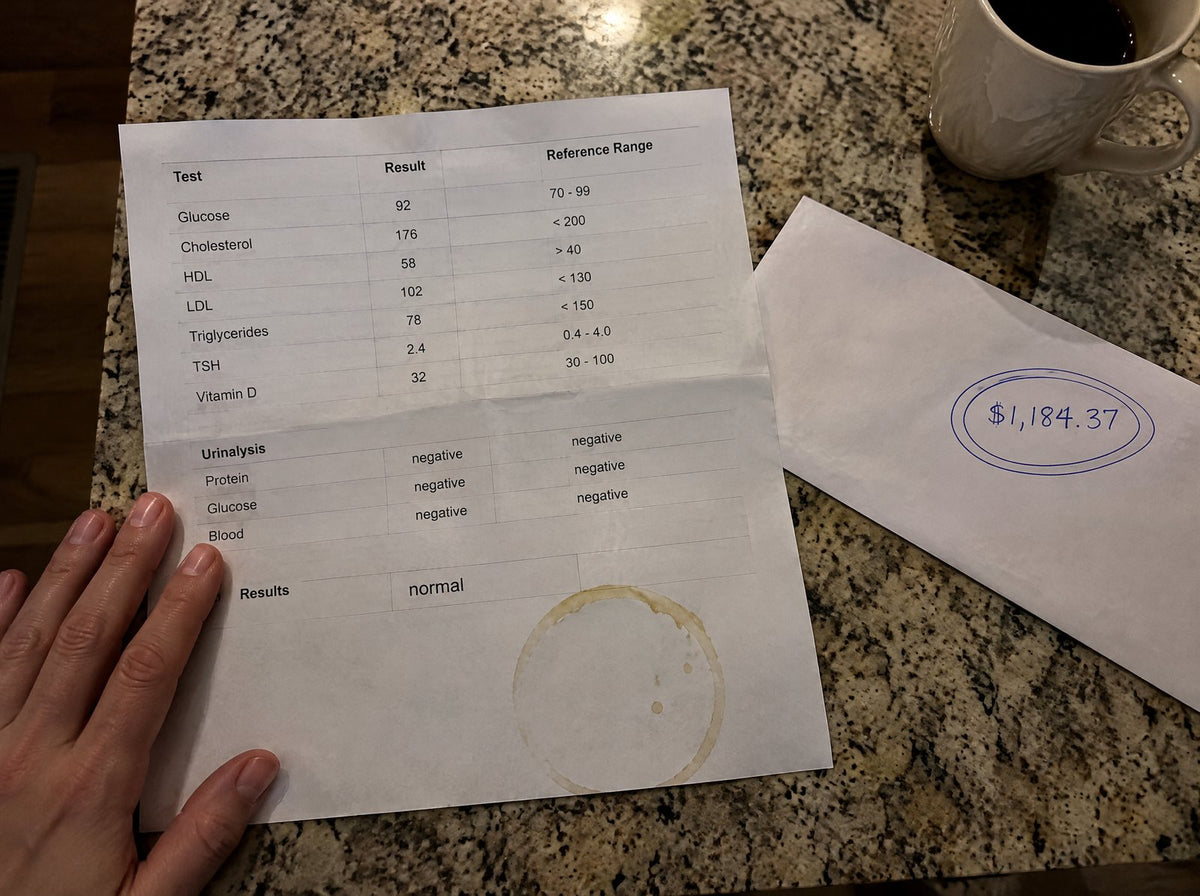
On a Thursday night I sat at my kitchen counter with a pen, an envelope and two years of digestion receipts.
The fridge hummed.
My coffee had gone cold. The pharmacy receipt curled off the counter.
I'm 57, and I added it up twice.
$1,184.37.
Two years of paying to feel like a rock after dinner.
Here's the night that made me do the math.
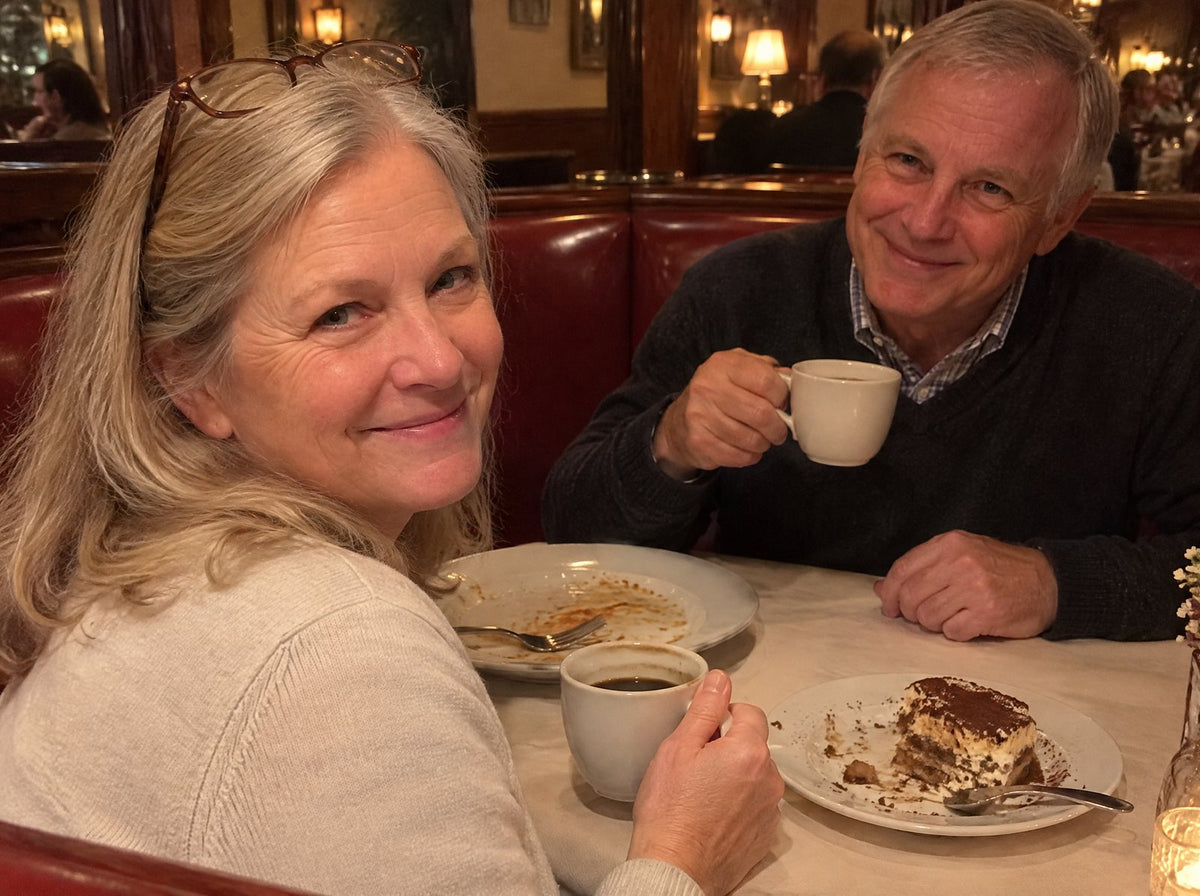
It was my husband Rick's 60th birthday, at the Italian place we've gone to since our first anniversary.
For two years I'd ordered the side salad there.
That night I thought: it's his 60th, I'm having the fettuccine Alfredo.
It came out all butter and garlic. I took my two digestive enzymes with the first bite, the way the bottle said.
Half the plate in, that heavy, stuffed feeling started, like the meal had parked under my ribs and shut the engine off.
At 8:47 the waiters came out singing with the cake. I couldn't sit up straight.
I spent his birthday dessert in our car in the parking lot, seat pushed all the way back, the window cold on my cheek, watching my family laugh through the restaurant glass.
Rick came out with a slice of cake wrapped in a napkin.
He didn't say anything.
He didn't have to.
He's watched me do this at Christmas, at our granddaughter's christening, at every steakhouse for two years.
At home, I went straight to the drawer.

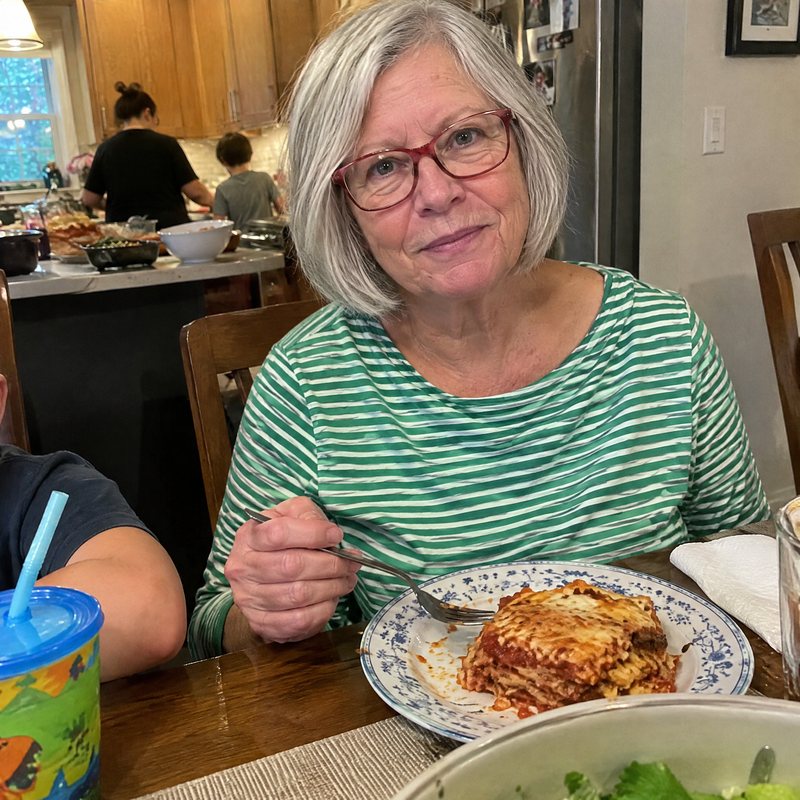
Rick's 60th, from the parking lot.

My drawer. Two good weeks a bottle, at best.
You probably have a drawer like mine, next to the stove, where the digestion bottles go to die.
I dug out every receipt:
Total: $1,184.37, not counting the cookbooks or the month I cut out cheese.
The money wasn't even the worst part.
The worst part: the enzymes did something.
I'd started them in August, on grilled fish and tomato salads, and felt lighter after every meal.
Two. Good. Weeks.
Then October brought meatloaf with gravy, cream sauces and Rick's chili with the cheese melted on top, and the heavy dinners won again.
My doctor ran the usual tests, all normal: "Probably just gas."
So I blamed my age, my hormones, my body getting used to the enzymes.
What I never told anyone: I'd started choosing restaurants by how close the car could park.
Then our son Danny came for supper.

Every test said normal. The envelope said $1,184.37.

Danny, 31, teaches high school chemistry.
He saw the envelope with $1,184.37 circled on it and asked what it was.
When I told him, he didn't laugh. He went to the pantry and came back with a mason jar.
He filled it halfway with water, poured in a good glug of olive oil, shook it hard and set it down.
"Watch."
For a few seconds the oil went cloudy, then crept back into one gold layer, slow as syrup.
"That's your fettuccine sauce after it leaves your stomach," he said. "One big greasy lump."
Then he squirted in some of my lemon dish soap, and the kitchen smelled like lemons as he shook it again.
This time the oil broke into tiny droplets and stayed that way for the five minutes we watched.
“Your enzymes were never the wrong idea, Mom,” he said. “They were working alone.”
They were missing their partner. For two years I hadn't bought the wrong bottles. I'd bought half a pair.
My enzymes did their half alone, on a lump they couldn't get into. And it wasn't just my age, or just my hormones.

Same jar, same oil. On the right, it had a partner.
"Your body makes its own dish soap," Danny said. "It's called bile."
The lipase in my enzymes, the part that handles fat, can only work on the outside of fat, where it touches water.
One big greasy lump has hardly any outside.
Break it into thousands of tiny droplets, and there's outside everywhere.
That's bile's job: it breaks the fat of a rich meal into tiny droplets, so the enzymes have something to work on.
August was grilled fish and tomato salads, not much fat, and my enzymes kept up on their own.
Rick's birthday was fettuccine Alfredo: a lot of fat, arriving as one big lump.
"And a rich meal slows your stomach down while it waits for the fat to be handled," Danny said. "I call it the fat brake. Researchers measured it back in 2001: when fat reaches your gut, your stomach relaxes and holds on to the meal. That's the heavy feeling."
"So when the bile is slow to show up, the whole meal waits. Slow bile is one reason heavy meals sit."
"Your doctor was looking for something broken," he said. "Nothing's broken. Your enzymes just never had any help when the fat landed."
You can see it tonight with a jar.

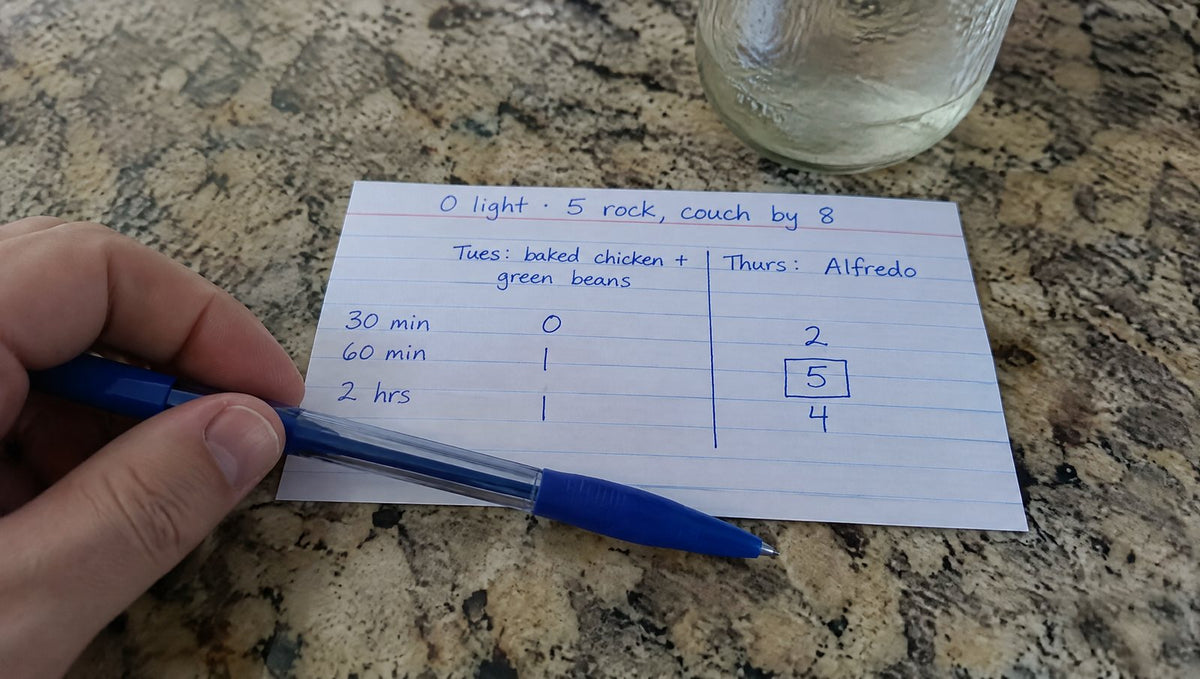
Danny's score card. The plain supper barely moved the pen.
Shake water and olive oil in a jar and watch it crawl back into one layer. Add dish soap, shake again, and the droplets hold.
Then do what Danny made me do, since he grades things for a living: score one plain supper and one rich one at 30, 60 and 120 minutes. 0 is light and still at the table. 5 is a rock, on the couch by eight.
My Tuesday, baked chicken and green beans: 0, 1, 1.
My Thursday, homemade Alfredo: 2, 5, 4.
It was never my whole stomach: it was the fat, and the partner that showed up too late for it.
Five weeks later, that card mattered.

What Danny and I wrote at the counter.
"So do I need to take bile?" I asked him.
That night we wrote down what a fix had to do:
My drawer failed that list: probiotics, milk thistle and peppermint did nothing at the fat, my enzymes had no partner, and the month without cheese just took the meal away.
Most of what we found was one or the other.
One had bile salts and enzymes in the same capsule, plus the artichoke.
A registered dietitian, Maren Holt, MS, RD, LDN, had reviewed its formula.

Day 1: meatloaf, one capsule, first bites.
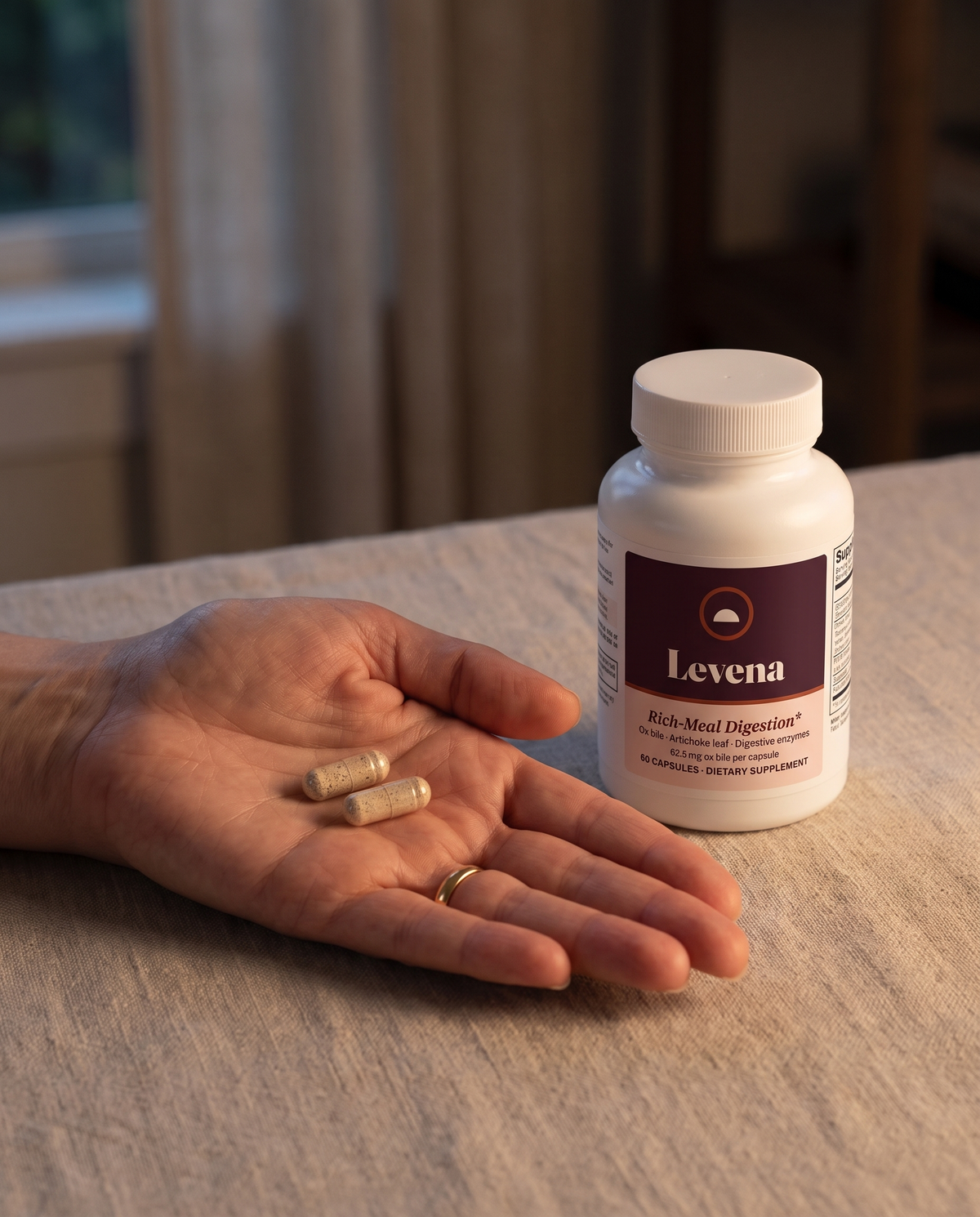
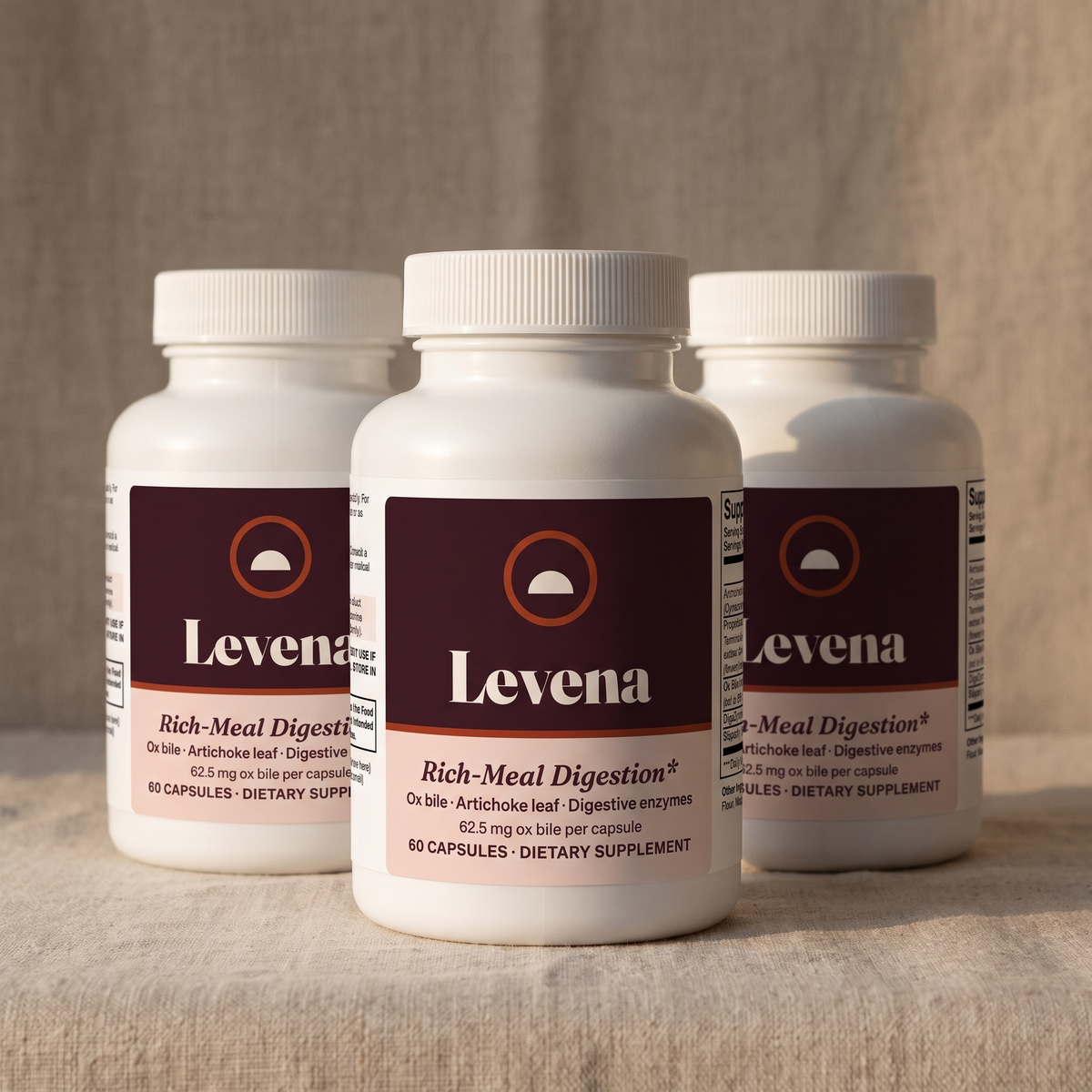
It's called Levena Rich-Meal Digestion Capsules, and each part answers a line of our list:
One capsule at the first bites of your biggest rich meal for the first 4 days, then two a day, one with each of your two biggest meals, never on an empty stomach.
Keep your enzymes if you like them: Levena has five of its own.
I'd been burned by "advanced" before, at $239.
So when the box came, Danny opened one capsule over a fresh jar of oil and water and shook it.
Cloudy. Tiny droplets. Same as the dish soap.
He left that jar next to my coffee maker, and it's still there.
Then I read the label twice.

Two capsules a day: one at the first bites of each of my two biggest meals.

The back label. The main doses are printed in milligrams.
I don't trust a bottle until I've read the back of it, so here it is.
Two capsules carry: - Artichoke leaf extract, 500 mg, studied for bile flow* - Ox bile, 125 mg, which is 62.5 mg in each capsule: the bile salts that break fat into tiny droplets* - DigeZyme®, 50 mg: five digestive enzymes, lipase included, the one that works on fat* - Slippery elm bark, 40 mg: a soothing inner bark - A 300 mg herbal blend (Terminalia chebula and Sphaeranthus indicus). They name both herbs; they don't give the split.
A bottle is 60 capsules, a month at two a day. Manufactured in the USA using globally sourced ingredients. The capsule is gelatin and the bile is from cattle, so it isn't vegetarian.
I want to be straight about the size of it, because I've read too many labels that weren't. 62.5 mg is a small amount on purpose. It's a top-up at the meal, not a new set of insides. The point is the timing: it's there when the fat lands.
And they print who should not take it, which I've never seen a digestion bottle do so plainly: anyone with known gallstones or a blocked bile duct (unless their doctor agrees), anyone pregnant or breastfeeding, anyone allergic to daisies, ragweed or artichoke. If your stools are loose and urgent most days, it's the wrong kind of help, and they say so.
That list is the reason I believed the rest.

Week 5. Same booth. This time I stayed for the coffee.
Day 1. Meatloaf with gravy, one capsule with the first bites. After supper I walked the dog with Rick, cold air in my lungs, instead of lying down.
Day 3. Fried shrimp at the church potluck, still on my one starting capsule. Hold that thought.
Day 5. Two a day now, one with lunch and one with dinner.
Week 2. Rick's chili with the cheese on top. I had seconds, then watched the game next to him, sitting up.
About that shrimp: it was better than before, but it still sat for a while.
Deep-fried food is still the one meal it doesn't fully fix for me.
Week 5. The Italian place, the same booth, the same fettuccine Alfredo.
I ate the whole plate, and then I had the tiramisu.
Rick watched me the whole time.
On Danny's card that night I wrote 1, 1, 0.
In the car (the same car) he said, "So we're coming back next year?"
I cried a little on the way home.
Not because of the pasta.
Because of two years of parking lots.


Readers at their own tables.
The night of the jar, Danny had read me the reviews.
"Kept my enzymes. Added this. Pizza night is back on the calendar." — Marcy, 54
"My brisket used to sit till midnight. Now I'm done feeling it before the dishes are done." — Lorna, 61
"My sister's pot roast used to send me to the porch swing. Last month I stayed for cards." — Gail, 58, Bowling Green, Kentucky
"My grandson thought the jar was a magic trick. Lasagna night doesn't send me to the couch anymore." — Norma, 60, Huntington, West Virginia
Levena has ★ 4.8 from 2,318 reviews, most of them from women over 40. 6,200 women have taken the Greasy-Meal Test with it. Fewer than 4 in 100 ask for their money back.
"I'm 56 and I'd made peace with skipping dessert at every family dinner. First Easter in years I had the ham, the scalloped potatoes and the pie, and I helped with the dishes." — Gina, 56, Columbus, Ohio
"Four stars because it took me about ten days to notice. Then I noticed every night." — Terri, 59, Knoxville, Tennessee
Two years of the drawer came to $1,184.37, and not one bottle in it offered my money back. This is about $1.43 a day, and it does.
The one I'd pick is the 3-bottle box: about $1.43 a day, 90 days, which is exactly as long as their guarantee runs, and free shipping.
It comes with five free gifts they value at $94, sent to your email the day you order. The two I actually use are the Greasy-Meal Test card and the Meal-Matched Dose Card (which meal, how many capsules, when to stop). There's also a Doctor Sheet you can print for your doctor, and a Rich-Meal Playbook.
The fifth has a date on it. If you're cooking Thanksgiving this year, the Holiday Table Plan comes with 3 or 6 bottles ordered by Mon, Nov 16. That's their cutoff to get the bottles to your door in time to try them before the big meal. It ships from Denver, CO in 2-5 business days.
It's a one-time purchase. No subscription, nothing to cancel. I checked twice.
And then there's the part that made it an easy yes for me: the Clean-Plate Guarantee. Take it with your rich meals for up to 90 days. If they don't sit lighter (you judge it on your own Greasy-Meal Test), you email them and they refund your first order. Nothing to send back, not even the empty bottles. You keep the gifts.
You'll know on your own plate. That's the only test that ever mattered to me.
You're where I was with that envelope.
That came to about $1.62 a day, and not one of those bottles ever offered my money back.
Path one: another bottle for the drawer. Two good weeks, then the next heavy dinner, then the parking lot.
Path two: the jar, then one test at your own table, with 90 days to judge it.
Here's what happens when you order:
And if you're thinking what if it's just me: if your rich meals don't sit lighter, you get your first order back and keep the gifts.
Try Danny's jar tonight. That oil crawling back into one layer is the meal your enzymes have been working on alone.
Last month I cleaned out the drawer. I kept one enzyme bottle, the one I like, and threw out the rest.
For two years, my enzymes had been working alone.
The enzymes finally had something to work on.

It's a small company that makes one product, for one moment: the first bites of a rich meal. The doses are on the label in milligrams, and their registered dietitian, Maren Holt, MS, RD, LDN, reviewed the formula.
It's meant to be. It's a top-up timed to the meal, not a replacement for anything your body makes, and it starts at one capsule for the first 4 days so you can feel how your body takes it. The artichoke leaf in it is the herb tested in a 244-person placebo-controlled trial for that too-full feeling after meals (a different extract and dose from ours).*
I've heard ox bile made people worse.
Usually that's a 1,000 mg bottle taken by someone whose problem is the opposite one: loose, urgent stools, often after gallbladder surgery. For them, more bile is the wrong help. That's why Levena starts at 62.5 mg, and why their 30-second quiz for people without a gallbladder turns about 1 in 3 away. If you get loose stools after starting, stop.
Artichoke and one of the blend's herbs are in the daisy family. If you're allergic to daisies, ragweed or artichoke, it isn't for you.
No subscription: it's a one-time purchase. And there's nothing to return: if your rich meals don't sit lighter within 90 days, email hello@trylevena.com and they refund your first order. Keep the bottles, keep the gifts.
Take the label, or the Doctor Sheet that comes with the 3- and 6-bottle boxes: one page with what's in it, every known dose and the warnings. Don't take it with known gallstones or a blocked bile duct unless your doctor agrees. If you take a bile-acid binder, Levena goes at least 1 hour before it or 4-6 hours after it: ask your doctor.
Start with one capsule at the first bites of your biggest rich meal for the first 4 days, then two a day, one with each of your two biggest meals. Never on an empty stomach. Most people keep it for the meals that used to sit: Sunday lunch, restaurant nights, the holiday table.
No. The bile is from cattle and the capsule is gelatin.
No. Levena has five digestive enzymes of its own, lipase included, in the same capsule as the bile salts. If you like yours, you can keep them. Take Levena at the first bites either way.