Read this before another bottle goes in the drawer.
For two years I left my own Sunday table before the coffee. The reason was never in my head, and I got that table back.

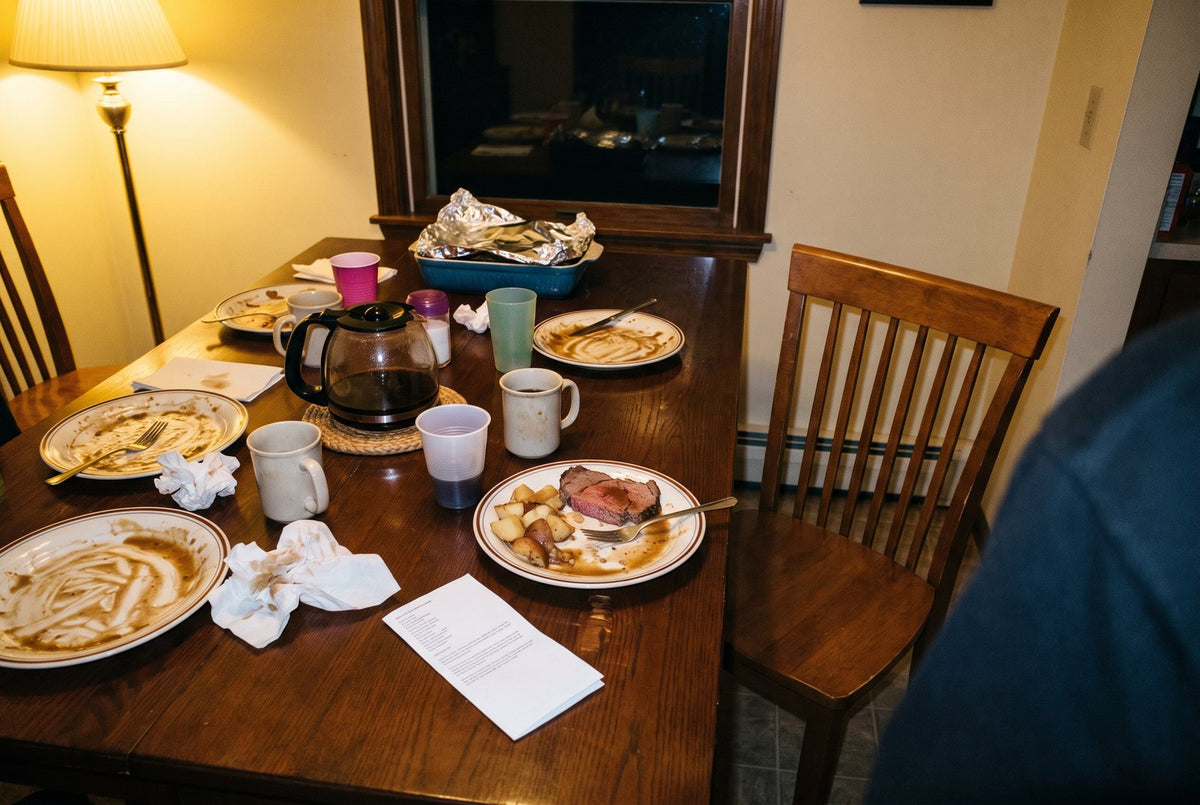
My chair. My roast, six bites in. The coffee was just coming out.
The gravy was still warm in the boat when I pushed my chair back.
I'd cooked four pounds of beef for seven people. I'd eaten maybe six bites.
I said I had laundry to switch. I didn't.
I sat in the dark on the step stool by the dryer and listened to my own family pour the coffee without me.
If you've ever made up a reason to leave your own table, or stayed in your chair smiling while dinner sat like a rock, this is for you.
Here's the Sunday I started writing it down.

Two Sundays, the same note.
I make that roast the way my mother did every Sunday of my childhood: the good gravy, potatoes in butter, the kitchen windows steamed up by noon.
Ray, my husband, carves. Our son Tom and his wife Kayla bring their two boys. My sister Fran brings her peach cobbler.
By 6:52, Kayla was stacking plates and the food was sitting in me like a rock.
Not full. Heavy, high under my ribs, like the meal had parked and was waiting.
Through the laundry-room door I heard the coffee maker gurgle, Fran laughing, and Tom starting the fishing-trip story I'd waited all week for.
Ray came in and leaned on the dryer. Thirty-one years married, and he knew not to say a word.
At 7:15 I lay down upstairs in my clothes while he served the cobbler.
Later I wrote "bed, 7:15" on the kitchen calendar.
I wanted proof it was happening.
At 12:40 I gave up and slept sitting against two pillows.
Two years of Sundays like that. Roast. Rock. Bed.
So I went looking for a fix.

The drawer by the stove. None of it touched Sunday.
Breakfast never sat. Lunch never sat.
It was the rich meals: the roast, lasagna, Friday fried fish, anything with butter, cream or skin.
So I worked down the list. Whatever came in a bottle or a box ended up in the drawer by the stove:
Running total: $191.42.
None of it touched the rock.
Every one of them was for my stomach in general. Not one was there at the moment the roast landed.
The doctors had even less to say.

I read it three times in the parking lot.
I don't blame my doctor. She's a kind woman.
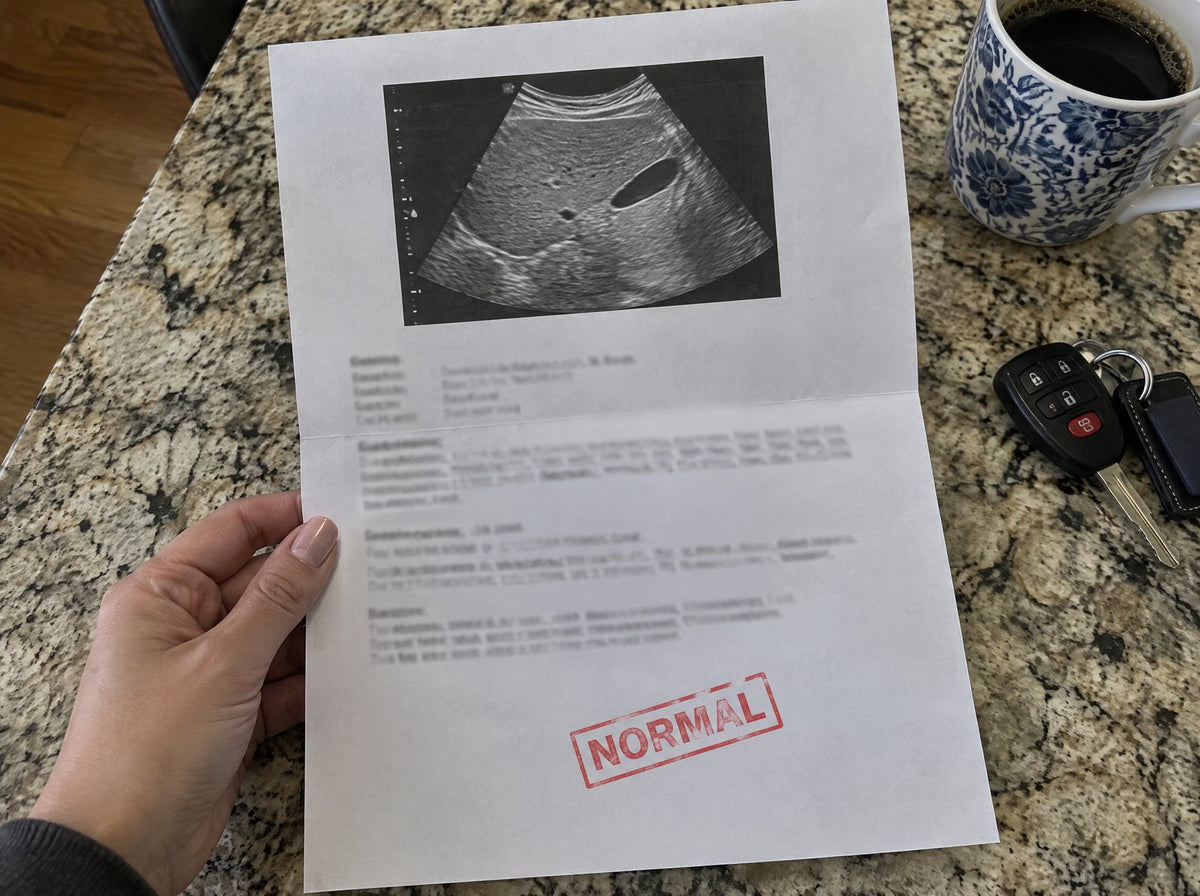
The ultrasound was normal. The bloodwork was normal. My thyroid was normal.
In February they'd put me under for a scope. Normal too.
The Thursday before that Sunday, she smiled at her screen.
"Everything looks great, Joanne. At 52, this is probably hormones. Maybe a little IBS."
I'm 52. Everything is hormones.
So why did my hormones wait for a pot roast?
Here's the part I never say out loud: I had started to dread my own Sundays.
My grandsons run to that table. And I was the one leaving it early.
When every paper says you're fine, you stop telling anyone.
But one person had already asked me the right question. I just hadn't listened.

Glenda, the morning of my scope.
Her name was Glenda. Gastroenterology nurse, reading glasses on a beaded chain.
It was the morning of that February scope. The bay smelled of hand sanitizer and warm blankets.
Taping in my IV, she asked what brought me in.
"My dinner sits like a rock until midnight," I said, "and nobody can find anything."
She didn't write it down. She asked me a question.
"What time did you eat, and what was on the plate?"
Nobody had asked me that. Not once in two years.
Rich dinners, I told her. Never breakfast. Worst on Sundays.
"Honey, your scope's going to come back normal. It takes pictures. What you're describing is timing."
Then she said one more thing. At home I wrote it on a sticky note and stuck it inside a cabinet.
I left it there for weeks.
Then came that Sunday. At 11:48, sitting up against two pillows, I typed the whole thing into one of those AI chat apps on my phone: normal ultrasound, normal bloodwork, 52, so why does dinner sit like a rock until midnight?
It said hormones were part of it. Then it asked what was on my plate, and when.
Glenda's question. Twice now.
I went downstairs and opened the cabinet.
"Your hormones are part of your story at this age. They're not the part that happens an hour after the roast."
It was never in my head. It was never only my age. Not just my hormones. Timing.

The fat brake: dinner waits until bile walks in.
When the fat of a rich meal reaches the top of your small intestine, it sends word back up: slow down.
Your stomach relaxes, holds the meal and waits.
Glenda called it the fat brake.
It's waiting for bile.
Bile breaks fat into tiny droplets, so your enzymes have something to work on.
Then the brake comes off and the meal moves along.
Picture a host who won't serve dinner until the last guest walks in. Your stomach is the host. Bile is the late guest.
When bile is slow to arrive, the meal sits with the brake on. That's the rock.
That's why toast never sat and the roast always did. Gravy stands on the brake.
"Slow bile is one reason a heavy meal sits," Glenda said. "And it's the one nobody checks."
As for my tests: "An ultrasound looks for stones. A scope looks at the lining. A picture can't see what time something shows up."
But first I wanted proof.

Same chicken. The only change was the fat.
Glenda's question was really a test. So I ran it.
Tuesday: chicken and rice, no skin, no gravy.
I scored the heaviness at 30, 60 and 120 minutes, 0 for light, 5 for the rock.
0, 1, 0.
Thursday: the same plate with the crispy skin and gravy, the kitchen smelling like a Sunday.
3, 5, 5.
Same chicken, same me, same hormones. The rock followed the fat.
Later I found out the company I'm about to tell you about prints this test on a card, the Greasy-Meal Test.
Mine was on the back of the electric bill.
You can run it this week. Same plate two nights, once plain and once the way you like it, scored at 30, 60 and 120 minutes.
If your numbers follow the fat like mine did, keep reading.
Now I knew why. The question was what to do.

My five rules, on the fridge.
Back in February, I'd asked Glenda what her other patients do about it.
Some take bile salts and artichoke with the first bites, she'd said. "Not after. With the food, so the help gets there when the meal does."
So I wrote down five rules, straight from the fat brake:
I didn't want to give up the roast. I wanted the roast to move.
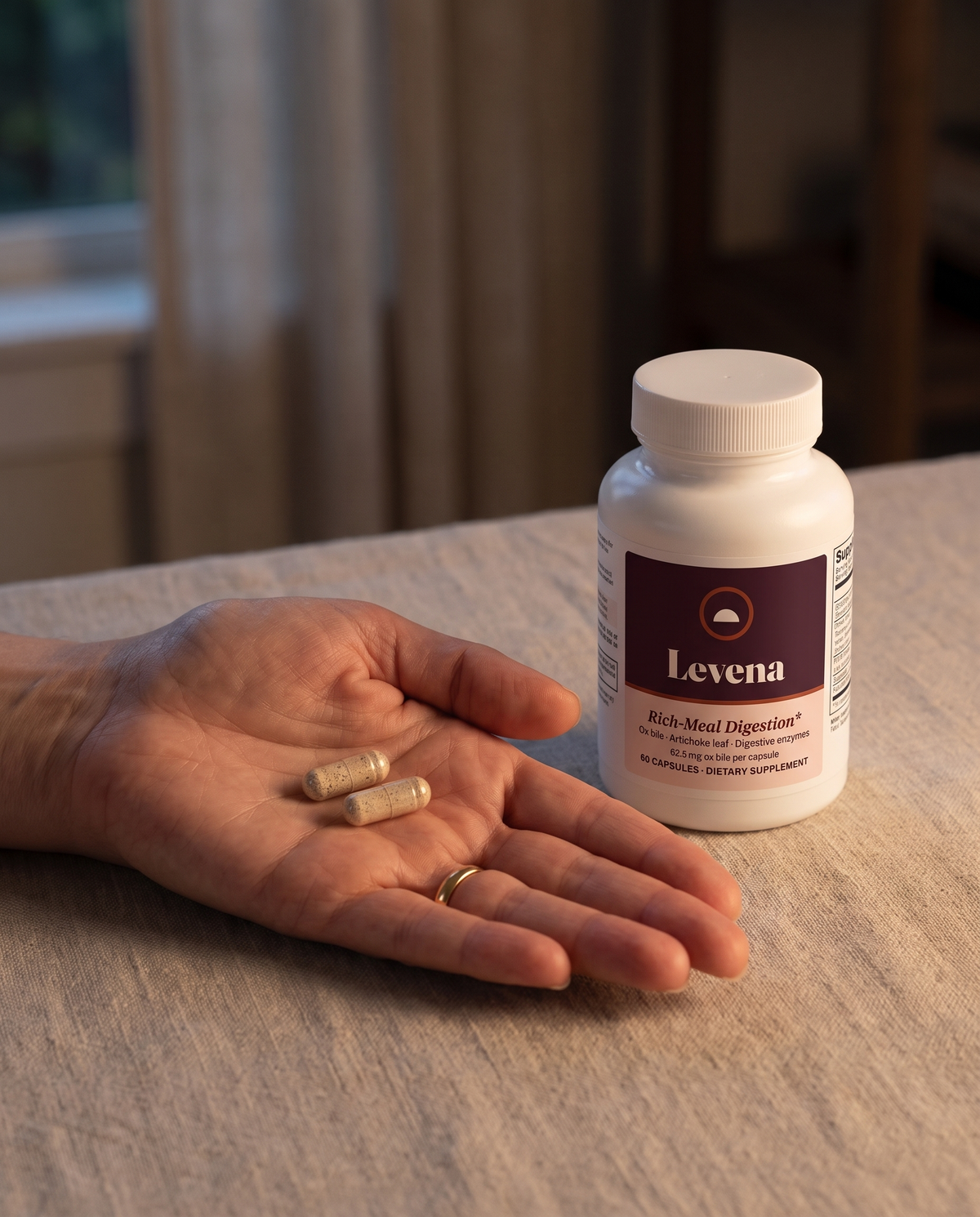
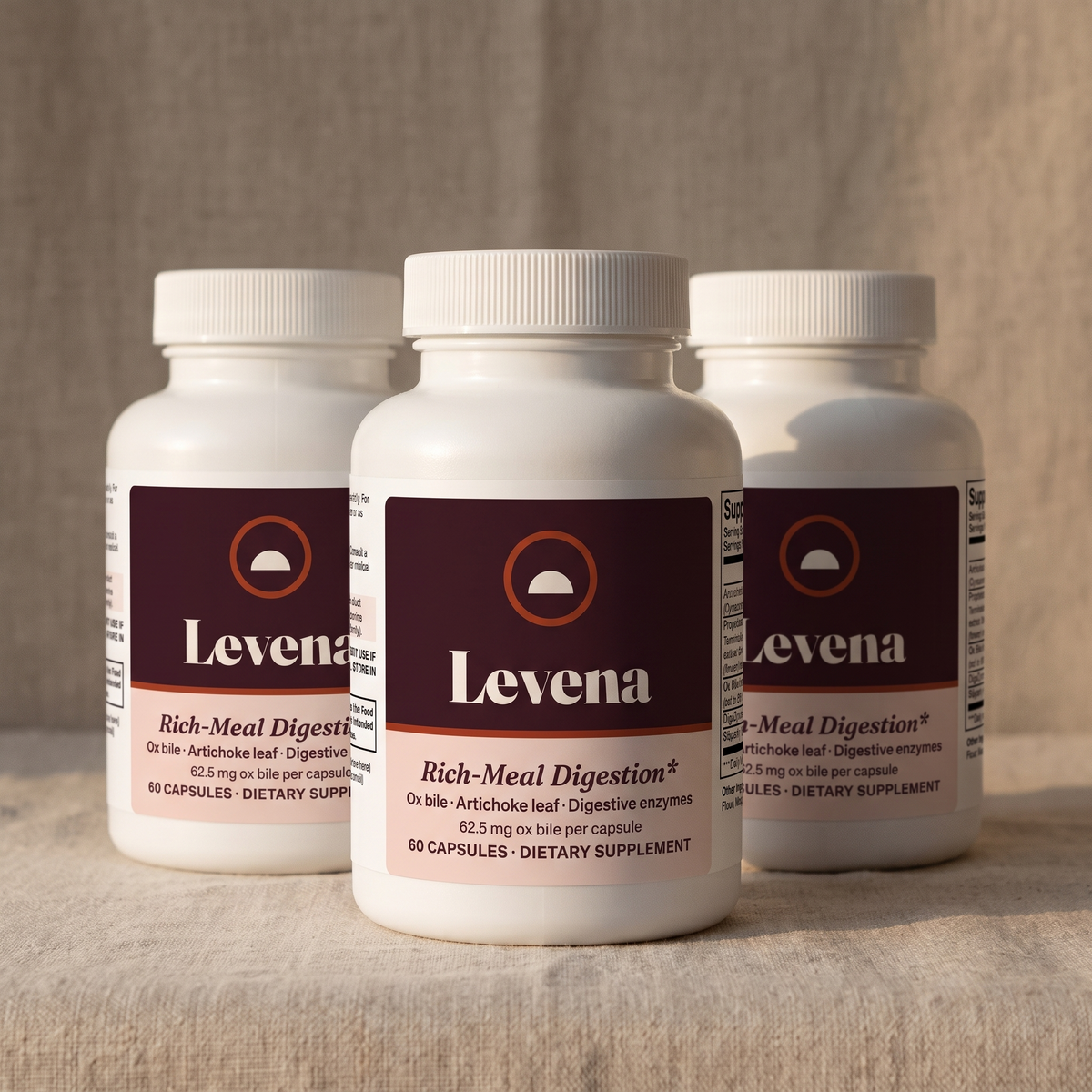
Then I found a small company that makes one thing, capsules for rich meals, and it met all five rules. It's called Levena.
Their registered dietitian, Maren Holt, MS, RD, LDN, reviewed the formula.
I still took the label to my follow-up.
My doctor read the back and handed it to me. "With food. Go ahead."

Next to the salt and pepper, so I can't forget.
The probiotic's box had promised "Bloat gone in 7 days." It's still in the drawer.
This one does what Glenda described, piece by piece:
Rules 1 and 5 are the directions.
One capsule at the first bites of your biggest rich meal for the first 4 days. Then two a day, one with each of your two biggest meals. Never on an empty stomach.
You don't take it in the morning and hope. You take it with the roast.

Two capsules a day: one at the first bites of each of my two biggest meals.

The back label. The main doses are printed in milligrams.
I don't trust a bottle until I've read the back of it, so here it is.
Two capsules carry: - Artichoke leaf extract, 500 mg, studied for bile flow* - Ox bile, 125 mg, which is 62.5 mg in each capsule: the bile salts that break fat into tiny droplets* - DigeZyme®, 50 mg: five digestive enzymes, lipase included, the one that works on fat* - Slippery elm bark, 40 mg: a soothing inner bark - A 300 mg herbal blend (Terminalia chebula and Sphaeranthus indicus). They name both herbs; they don't give the split.
A bottle is 60 capsules, a month at two a day. Manufactured in the USA using globally sourced ingredients. The capsule is gelatin and the bile is from cattle, so it isn't vegetarian.
I want to be straight about the size of it, because I've read too many labels that weren't. 62.5 mg is a small amount on purpose. It's a top-up at the meal, not a new set of insides. The point is the timing: it's there when the fat lands.
And they print who should not take it, which I've never seen a digestion bottle do so plainly: anyone with known gallstones or a blocked bile duct (unless their doctor agrees), anyone pregnant or breastfeeding, anyone allergic to daisies, ragweed or artichoke. If your stools are loose and urgent most days, it's the wrong kind of help, and they say so.
That list is the reason I believed the rest.

Two Sundays later: coffee, cobbler, the whole fishing story.
The next Sunday, I made the same four pounds of beef, the same gravy, the same potatoes in butter.
Sunday one. One capsule with my first bites.
I ate a real plate. Not six bites. A plate.
It sat lighter. I made it through dessert, and what I felt was full, the ordinary kind.
Day 5. Two a day now, one with lunch and one with dinner.
Friday was fried fish. At ten I was doing the crossword lying down.
Two weeks after that first capsule. Same roast. Same seven people.
I poured the coffee. I had a bowl of Fran's peach cobbler, still warm, the edges crunchy.
I heard Tom's whole fishing-trip story, down to the cooler going in the lake.
On the calendar I wrote "coffee, cobbler, 9:40."
Ray said nothing until everyone left.
Then he leaned out of the bathroom, toothbrush in his mouth.
"You stayed at the table."
The ultrasound report hangs on my fridge under a magnet. It still says normal. My Sundays don't.
That was nine weeks ago. A bottle lives in my purse now, for restaurant nights.
It's help with the first bites of a rich meal, not a cure for everything that changes at 52.
But for the part that happens after the roast, it's the first thing in two years that worked.



Women who wrote to me after I shared this.
"Normal scans for three years. First chicken parm in forever that didn't sit till midnight." — Sharon, 49, Dayton, Ohio
"Ultrasound normal, bloodwork normal, and my pot roast still sat till bedtime. Two weeks in, I stay for dessert." — Peggy, 55, Springfield, Missouri
"Fried fish Fridays are back, and I sleep lying down." — Rita, 58, Grand Rapids, Michigan
"UPDATE: My scans are still normal. My Sunday roast just doesn't sit like a rock anymore. I stayed for coffee and cobbler." — Gloria, 54, Akron, Ohio, verified buyer
"My daughter noticed before I did. She said, 'Mom, you're still here.'" — Wendy, 55, Peoria, Illinois
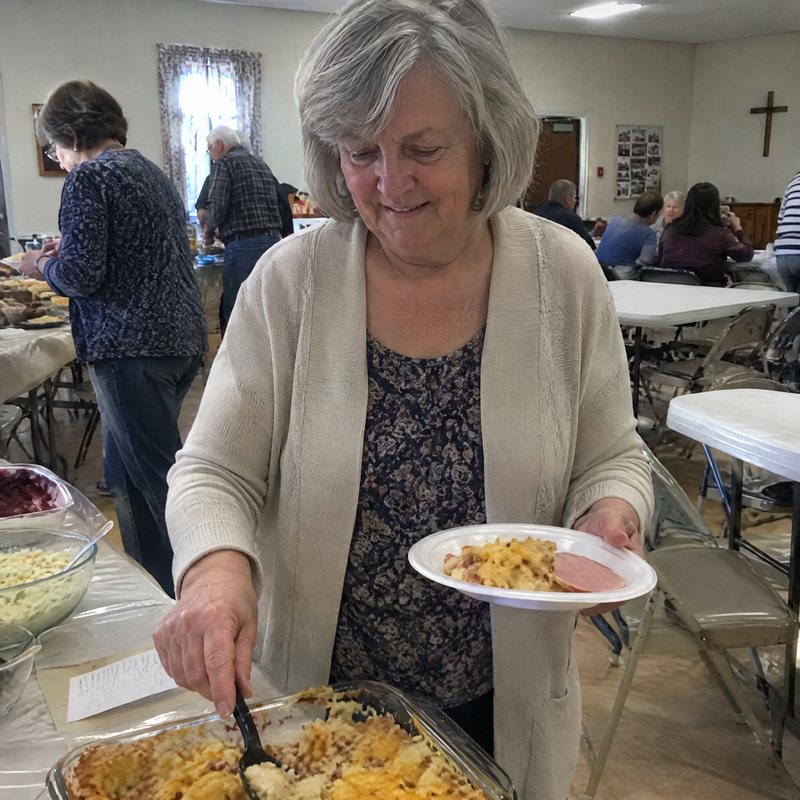
"Church potluck used to mean the couch till three. Sunday I had the ham casserole and stayed to fold tables." — Brenda, 60, Erie, Pennsylvania
Levena has ★ 4.8 from 2,318 reviews, most of them from women over 40. 6,200 women have taken the Greasy-Meal Test with it. Fewer than 4 in 100 ask for their money back.
"I'm 56 and I'd made peace with skipping dessert at every family dinner. First Easter in years I had the ham, the scalloped potatoes and the pie, and I helped with the dishes." — Gina, 56, Columbus, Ohio
"Four stars because it took me about ten days to notice. Then I noticed every night." — Terri, 59, Knoxville, Tennessee
Two years is about a hundred Sundays I left before the coffee. This is about $1.43 a day.
The one I'd pick is the 3-bottle box: about $1.43 a day, 90 days, which is exactly as long as their guarantee runs, and free shipping.
It comes with five free gifts they value at $94, sent to your email the day you order. The two I actually use are the Greasy-Meal Test card and the Meal-Matched Dose Card (which meal, how many capsules, when to stop). There's also a Doctor Sheet you can print for your doctor, and a Rich-Meal Playbook.
The fifth has a date on it. If you're cooking Thanksgiving this year, the Holiday Table Plan comes with 3 or 6 bottles ordered by Mon, Nov 16. That's their cutoff to get the bottles to your door in time to try them before the big meal. It ships from Denver, CO in 2-5 business days.
It's a one-time purchase. No subscription, nothing to cancel. I checked twice.
And then there's the part that made it an easy yes for me: the Clean-Plate Guarantee. Take it with your rich meals for up to 90 days. If they don't sit lighter (you judge it on your own Greasy-Meal Test), you email them and they refund your first order. Nothing to send back, not even the empty bottles. You keep the gifts.
You'll know on your own plate. That's the only test that ever mattered to me.
Path one: another bottle for the drawer, and the holidays on the step stool.
Path two: one test at your own table, with 90 days to judge it on your own plate.
Path two goes like this:
And the fear I had? What if it's just me, and nothing works? Then you get your first order back and keep the gifts.
Two years is a long time to leave your own table.
I was still at the table when the coffee came out.
Not just my hormones. Timing.
— Joanne

It's a small company that makes one product, for one moment: the first bites of a rich meal. The doses are on the label in milligrams, and their registered dietitian, Maren Holt, MS, RD, LDN, reviewed the formula.
It's meant to be. It's a top-up timed to the meal, not a replacement for anything your body makes, and it starts at one capsule for the first 4 days so you can feel how your body takes it. The artichoke leaf in it is the herb tested in a 244-person placebo-controlled trial for that too-full feeling after meals (a different extract and dose from ours).*
I've heard ox bile made people worse.
Usually that's a 1,000 mg bottle taken by someone whose problem is the opposite one: loose, urgent stools, often after gallbladder surgery. For them, more bile is the wrong help. That's why Levena starts at 62.5 mg, and why their 30-second quiz for people without a gallbladder turns about 1 in 3 away. If you get loose stools after starting, stop.
Artichoke and one of the blend's herbs are in the daisy family. If you're allergic to daisies, ragweed or artichoke, it isn't for you.
No subscription: it's a one-time purchase. And there's nothing to return: if your rich meals don't sit lighter within 90 days, email hello@trylevena.com and they refund your first order. Keep the bottles, keep the gifts.
Take the label, or the Doctor Sheet that comes with the 3- and 6-bottle boxes: one page with what's in it, every known dose and the warnings. Don't take it with known gallstones or a blocked bile duct unless your doctor agrees. If you take a bile-acid binder, Levena goes at least 1 hour before it or 4-6 hours after it: ask your doctor.
Start with one capsule at the first bites of your biggest rich meal for the first 4 days, then two a day, one with each of your two biggest meals. Never on an empty stomach. Most people keep it for the meals that used to sit: Sunday lunch, restaurant nights, the holiday table.
No. The bile is from cattle and the capsule is gelatin.